Table of Contents
Pennsylvania chimneys take a consistent beating. The state’s freeze-thaw cycles — which run from late October through March — apply relentless stress to mortar joints, clay flue tiles, crowns, and the cap assemblies that protect the flue from above.
The repair categories that account for 90% of what we diagnose in Bucks and Montgomery County are: flue liner failure, mortar joint deterioration (repointing), crown damage, and cap replacement. This guide breaks down what each costs, what drives price variation, and how to identify which repair your chimney actually needs.
The Four Core Chimney Repairs: Costs and Scope
1. Chimney Liner Replacement
What is a chimney liner?
A chimney liner is the system inside the flue that contains combustion gases, directs them out of the structure, and protects the surrounding masonry from heat and corrosive byproducts. NFPA 211 and IRC Section R1003 require a functioning liner on all residential chimneys. In Pennsylvania, a failed or absent liner is an immediate safety issue — not a deferred maintenance item.
There are three liner types in common residential use:
| Liner Type | Application | Cost Installed — PA (2026) |
|---|---|---|
| Stainless steel flexible | Gas, oil, or wood — all fuel types | $2,200 – $4,800 |
| Aluminum flexible | Gas appliances only (not wood) | $1,400 – $2,600 |
| HeatShield / poured ceramic | Repair for intact but cracked tile flues | $1,800 – $3,800 |
| Full clay tile relining | Part of a full chimney rebuild | $4,500 – $9,000+ |
What drives the cost:
- Flue height. A two-story colonial in Doylestown with a 28-foot flue costs more than a ranch with an 18-foot flue. Every additional 5 feet adds roughly $150–$250 in liner material and labor.
- Liner diameter. A 6” liner vs. an 8” liner represents a material cost difference of $8–$12 per linear foot.
- Appliance type. A wood-burning fireplace liner requires stainless steel — not aluminum — and frequently requires insulation wrap between the liner and existing flue walls to maintain draft. This adds $300–$600 to the total.
- Top and bottom termination hardware. The liner cap, rain cap assembly, and appliance connector add $200–$450 depending on configuration.
Signs a liner needs replacement or repair:
- A Level II inspection (required after a chimney fire, home sale, or fuel type change) shows cracked tile, spalling, or joint failure inside the flue
- White powdery deposits forming on the firebox interior walls
- Smoke spillage into the room during use
- Visible daylight through the flue when viewed from the firebox
2. Repointing (Tuckpointing)
What is chimney repointing?
Chimney repointing is the process of removing deteriorated mortar joints between masonry units and replacing them with fresh mortar to restore structural integrity and water resistance. In Pennsylvania’s climate, properly installed mortar lasts 25–30 years. After that window, deterioration is expected — the question is only how far it has progressed.
| Scope | Cost Estimate — PA (2026) |
|---|---|
| Minor pointing — 1 to 2 deteriorated courses | $400 – $900 |
| Standard chimney — moderate joint failure | $900 – $2,200 |
| Full chimney tuckpointing — extensive failure | $2,200 – $5,000 |
| Repointing + crown repair | $1,300 – $4,500 |
| Repointing + flashing replacement | $1,600 – $5,500 |
What drives the cost:
- Extent of joint failure. Minor deterioration on two or three courses is a half-day job. Full chimney repointing where every joint course requires attention takes 1–3 days.
- Chimney height and accessibility. Any chimney requiring scaffolding rather than ladder access adds $400–$900.
- Mortar matching. Older homes in Doylestown, New Hope, and Ambler frequently have pre-1960 brick with softer mortar formulations. Using modern Portland-heavy mortar on these bricks causes cracking in the brick face — not the joint — because the brick is softer than the new mortar. Proper mortar matching (Type O or a field-mixed formulation) adds time but is non-negotiable on pre-war masonry.
Signs your chimney needs repointing:
- Mortar joints visibly recessed more than ¼ inch from the brick face
- White staining (efflorescence) running down the chimney exterior
- Small pieces of mortar or grit collecting at the base of the chimney
- Mortar that crumbles under light finger pressure when tested from a ladder
3. Chimney Crown Repair or Replacement
What is a chimney crown?
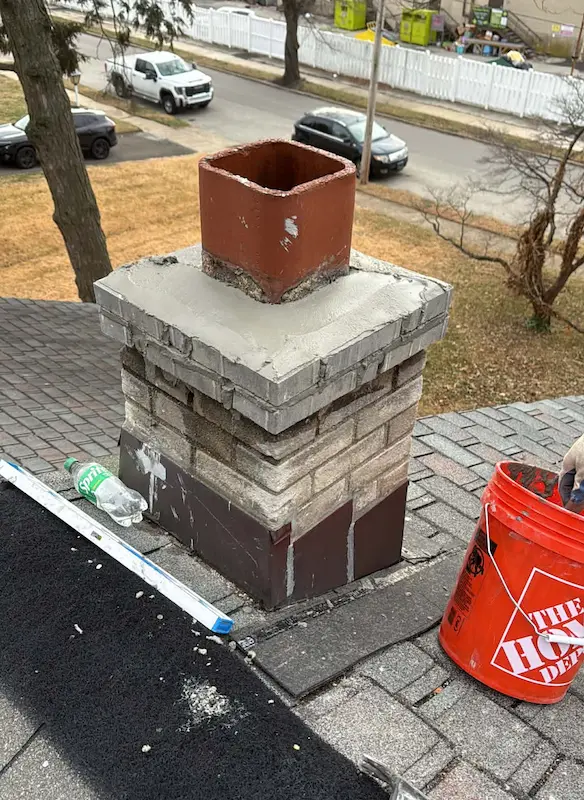
A chimney crown is the concrete or mortar slab that covers the top of the chimney structure, surrounding the flue liner opening. Its function is to direct water off the masonry cap and prevent infiltration into the flue and surrounding brick. A failed crown is the primary entry point for water into a chimney system in Pennsylvania — because it sits fully exposed to precipitation, UV, and freeze-thaw cycles year-round.
| Repair Type | Cost Estimate — PA (2026) |
|---|---|
| CrownCoat or elastomeric sealant — minor cracks | $200 – $500 |
| Partial crown repair — edge or section failure | $400 – $900 |
| Full crown removal and replacement | $700 – $2,000 |
| Crown replacement with chimney cap upgrade | $950 – $2,600 |
When repair is sufficient vs. when replacement is required:
- Hairline cracks under 1/16” with no water penetration history: elastomeric sealant is appropriate
- Cracks wider than 1/16” or any structural section separation: full replacement is required
- “Flat” crowns — common on older PA homes where a contractor parged mortar with no overhang — fail systematically and require replacement with a properly designed shed crown
A chimney crown without at least a 2” overhang beyond the masonry face directs water onto the brick rather than away from it. This is a design deficiency, not a material failure, and sealant cannot correct it.
4. Chimney Cap Replacement
A chimney cap is the metal hood installed over the flue opening at the top of the crown. It prevents rain, birds, squirrels, and debris from entering the flue. A missing cap is one of the most common causes of sudden chimney blockages and unexpected interior water damage.
| Cap Type | Cost Installed — PA (2026) |
|---|---|
| Standard single-flue galvanized cap | $150 – $300 |
| Single-flue stainless steel cap | $200 – $450 |
| Copper cap | $350 – $700 |
| Multi-flue chase cover (prefab chimney) | $300 – $800 |
If a cap is missing or structurally failed today, this is a same-season repair. Water entering an uncapped flue during a Pennsylvania winter can damage the liner, firebox, and surrounding masonry within a single freeze-thaw season.
Combined Scope: What a Full Chimney Restoration Costs
Some chimneys require multiple repairs in the same project. These are realistic combined-scope costs for Bucks and Montgomery County in 2026:
| Project Scope | Estimated Total — PA (2026) |
|---|---|
| Repointing + cap replacement | $1,100 – $3,200 |
| Repointing + crown replacement + cap | $1,800 – $4,500 |
| Liner replacement + cap + crown | $3,200 – $7,000 |
| Full restoration — liner, repointing, crown, cap, flashing | $5,500 – $12,000+ |
A full restoration is not the norm. Chimneys that receive maintenance at proper intervals — inspection every 1–3 years, repointing as needed, cap and crown in good condition — rarely require the full scope.
What a Chimney Inspection Costs — and Why It’s the Starting Point
Before any repair scope can be quoted accurately, an inspection is required. Estimating chimney repair costs without examining the liner and crown directly is guesswork.
| Inspection Level | Description | Typical Cost — PA |
|---|---|---|
| Level I | Visual inspection, accessible areas only | $100 – $200 |
| Level II | Full inspection with camera system — flue interior | $175 – $350 |
| Level III | Invasive inspection — required when hidden damage is suspected | $400 – $900+ |
For a home you’re purchasing, a Level II inspection before closing is standard practice. For a chimney that has not been inspected in more than five years, a Level II is the appropriate entry point — not a Level I.
What Homeowner’s Insurance Covers — and What It Doesn’t
Pennsylvania homeowner’s insurance typically covers chimney damage from a sudden, accidental event — a direct lightning strike, falling tree, or hail storm. It does not cover:
- Deterioration from age or deferred maintenance
- Mortar joint failure from normal weathering
- Liner failure from creosote buildup
- Crown cracking from freeze-thaw cycles
This distinction matters when budgeting. The majority of chimney repairs are maintenance items — owner responsibility, not insurance claims. Understanding this before speaking with an adjuster prevents misaligned expectations on both sides.
The Consequence of Deferred Chimney Maintenance
Failed mortar joints allow water into the chimney structure. That water attacks the system from the inside: saturating the flue liner, infiltrating framing, and in a wood-burning or gas fireplace, creating a carbon monoxide and fire hazard through a compromised liner. This is why NFPA 211 mandates annual chimney inspections.
Water entering through failed mortar also travels laterally into adjacent attic framing. The scope of damage that begins as a $1,000 repointing project can expand to include:
- Chimney liner replacement: $2,000 – $4,500
- Crown reconstruction: $700 – $2,000
- Water-damaged roof deck and framing: $1,500 – $8,000
- Interior drywall repair: varies
None of this secondary damage is visible from the exterior during early-stage mortar failure. By the time it becomes visible, the project scope has already escalated significantly.
FREE ASSESSMENT
Not sure if you need a full replacement or just a repair?
A licensed PA contractor can give you a straight answer in 20 minutes — at zero cost.
Frequently Asked Questions
- How much does chimney liner replacement cost in Pennsylvania?
- Stainless steel flexible liner installation in Pennsylvania typically costs $2,200 to $4,800 for a single-flue chimney, depending on flue height, liner diameter, and accessibility. Gas appliance liners run lower; wood-burning systems with insulation wrap cost more.
- What is chimney repointing and how much does it cost in PA?
- Chimney repointing removes deteriorated mortar from masonry joints and replaces it with fresh mortar. In Pennsylvania, repointing a standard chimney costs $700 to $5,000 depending on the extent of joint failure and chimney height. Most single-family homes in Bucks and Montgomery County fall in the $900 to $2,500 range.
- How do I know if my chimney crown needs to be replaced?
- A chimney crown needs replacement when it shows cracking wider than 1/16 inch, missing edge sections, or any structural separation where pieces have detached. Minor hairline cracking can be sealed with elastomeric coating; any structural failure requires full crown removal and replacement.