Table of Contents
What Is Tuckpointing?
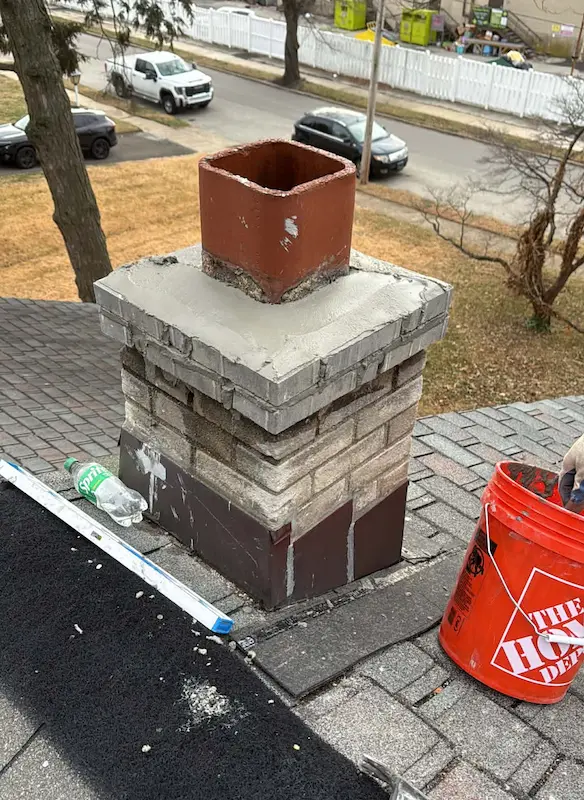
Tuckpointing is the process of removing deteriorated mortar from the joints between chimney bricks — or any masonry structure — and replacing it with fresh mortar to restore structural integrity and weatherproofing.
The brick itself typically lasts 100 years or more. The mortar holding it together does not. In Pennsylvania’s climate, where freeze-thaw cycles occur dozens of times between November and March, mortar joints require attention every 25–30 years. Miss that window and what costs $800 to repair becomes a $5,000 rebuild.
Why Chimney Mortar Fails in Pennsylvania
The failure mechanism is straightforward.
Water enters hairline cracks in aging mortar. Temperatures drop below freezing — which happens repeatedly throughout the Bucks County winter — and that water expands by approximately 9% as it freezes. The expansion widens the crack. When the ice melts, more water enters. The next freeze widens it further.
By the time a homeowner notices crumbling joints or white staining running down the chimney exterior, the freeze-thaw cycle has typically been working for multiple seasons. The damage is not recent. It is cumulative, and it accelerates once a threshold of joint failure is crossed.
Tuckpointing vs. Full Chimney Rebuild: When Each Applies
These two services address different levels of deterioration. They are not interchangeable.
| Tuckpointing | Full Chimney Rebuild | |
|---|---|---|
| What it addresses | Failing mortar; bricks are intact | Structurally compromised brick and mortar |
| Condition of bricks | Solid, not spalling or shifting | Cracked, spalling faces, or displaced |
| Typical cost — Bucks County | $700 – $5,000 | $3,500 – $12,000+ |
| Timeline | 1–2 days | 2–5 days |
| Structural result | Mortar joints restored | Chimney structure reconstructed |
Tuckpointing is the right service when mortar joints are recessed, crumbling, or missing — but the brick units themselves are solid, not moving, and not breaking apart at the face. A contractor confirms this with a tap test and visual inspection.
A rebuild is required when bricks are spalling (face layers breaking off), the structure has shifted, or so much mortar has failed that water has penetrated the chimney’s interior masonry. At that stage, tuckpointing is cosmetic on a compromised structure. It will not hold.
Signs Your Chimney Needs Tuckpointing
From the ground:
- Visible gaps or voids in the mortar joints
- Mortar that appears recessed more than ¼ inch from the brick face
- White staining (efflorescence) running down the chimney exterior
- Small pieces of mortar or grit collecting at the base of the chimney
- Water stains on interior ceilings or walls near the chimney
From the roof or a ladder:
- Mortar that crumbles when pressed with light finger pressure
- Joints that sound hollow when tapped
- Brick faces beginning to flake at the surface edges (early spalling — act immediately)
- Visible open joints when viewed at a low angle across the brick face
If you observe any three of the above, schedule an evaluation before the next heating season. Chimney mortar failure does not pause for calendar convenience.
How Tuckpointing Is Done: The Process Step by Step
Knowing the correct process helps you identify whether a contractor is doing the job properly.
Step 1 — Remove deteriorated mortar. An angle grinder or oscillating multi-tool cuts out old mortar to a consistent depth — typically ¾ inch to 1 inch. This step cannot be done shallowly. New mortar bonded over soft, crumbling material will fail within one to two freeze-thaw seasons.
Step 2 — Clean the joints. Compressed air or a stiff masonry brush removes dust, debris, and loose fragments. Contaminated joints prevent proper adhesion.
Step 3 — Match the mortar. This is the step most contractors get wrong, and it matters more than any other. Mortar has a compressive strength rating. New mortar applied to historic or aged brick must be softer than the brick itself. If modern high-strength mortar is used on older soft brick, freeze-thaw forces transfer into the brick rather than the joint — and the bricks crack instead of the mortar. A skilled mason selects or field-mixes mortar to match the original joint composition and hardness.
Step 4 — Pack and finish. Fresh mortar is packed into cleaned joints in layers, finished to match the original joint profile (flush, raked, or rodded), and tooled when it reaches partial set.
Step 5 — Cure and protect. Fresh mortar requires 24–48 hours of cure time. Tuckpointing should not be scheduled when temperatures are forecast below 40°F within 24 hours of installation — cold temperatures prevent proper hydration and weaken the final bond.
Tuckpointing Cost in Bucks County, PA
Pricing is driven by how many joint courses are failing, chimney height, and roof accessibility.
| Scope | Typical Cost — Bucks County (2026) |
|---|---|
| Minor pointing — 1 to 2 deteriorated courses | $400 – $900 |
| Standard chimney — moderate joint failure | $900 – $2,200 |
| Full chimney tuckpointing — extensive failure | $2,200 – $5,000 |
| Tuckpointing + chimney crown repair | $1,300 – $4,500 |
| Tuckpointing + flashing replacement | $1,600 – $5,500 |
Single-family homes in Doylestown, New Hope, and Yardley with a standard 30–35 foot chimney and accessible roof sections typically fall in the $900–$2,500 range for moderate joint failure.
Chimneys requiring scaffolding — taller structures or those with no safe roof access — add $400–$900 to the total.
What Happens If You Ignore Failing Mortar
The consequences are not cosmetic. They are structural and, in the case of active fireplaces, a safety issue.
Failed mortar joints allow water into the chimney structure. That water attacks the system from the inside: saturating the mortar liner, damaging the clay or stainless flue liner, and infiltrating framing where no inspector can see without a camera. In a wood-burning or gas fireplace, a compromised liner is a carbon monoxide and fire hazard. This is why NFPA 211 mandates annual chimney inspections — liner condition is not visible without dedicated equipment.
Water entering through failed mortar also travels laterally into adjacent attic framing and interior walls. The scope of damage that begins as a $1,000 tuckpointing project can expand to include:
- Chimney liner replacement: $2,000 – $4,500
- Chimney crown reconstruction: $500 – $1,400
- Water-damaged roof deck and framing repair: $1,500 – $8,000
- Interior drywall and finish repair: varies
None of this secondary damage is visible from the exterior during early-stage mortar failure. By the time it becomes visible, the project scope has already escalated significantly.
How Long Does Tuckpointing Last?
Properly installed tuckpointing mortar on a Pennsylvania chimney lasts 20 to 30 years — provided the mortar mix is correctly matched to the brick hardness, joints were cut to adequate depth, and the chimney has a functioning crown and cap to limit direct water infiltration from above.
Shortcuts at any of those three points reduce longevity sharply. Tuckpointing done with the wrong mortar mix or over insufficiently cleaned joints can begin failing within three to five years. This is why the lowest bid on a tuckpointing job is frequently the most expensive outcome.
Following tuckpointing, annual inspection — ideally before each heating season — catches any new joint failure before it progresses into the failure cycle described above.
Tuckpointing Is Maintenance, Not a Repair
The framing matters. Homeowners who view tuckpointing as a sign that something went wrong with their chimney tend to defer it. Homeowners who understand it as routine masonry maintenance — the equivalent of resealing a driveway or painting exterior trim — address it at the right time.
Your chimney’s brick is not failing. The sacrificial mortar between the bricks is doing exactly what it was designed to do: absorb freeze-thaw stress so the brick doesn’t have to. When that mortar has absorbed what it can, it gets replaced. That is the system working correctly.
The only mistake is waiting until the brick starts absorbing the stress instead.
FREE ASSESSMENT
Not sure if you need a full replacement or just a repair?
A licensed PA contractor can give you a straight answer in 20 minutes — at zero cost.
Frequently Asked Questions
- What is tuckpointing on a chimney?
- Tuckpointing is the process of removing deteriorated mortar from the joints between chimney bricks and replacing it with fresh mortar. It restores the chimney's structural integrity and weatherproofing without replacing the bricks themselves.
- How much does tuckpointing cost in Bucks County, PA?
- Tuckpointing a standard single-flue chimney in Bucks County typically costs between $700 and $2,800, depending on how many joint courses are failing and how accessible the chimney is. Extensive deterioration across the full chimney can run $3,000–$5,000.
- How long does tuckpointing last on a Pennsylvania chimney?
- Properly installed tuckpointing on a Pennsylvania chimney lasts 20 to 30 years. The brick itself can last over 100 years — mortar is the component that requires periodic maintenance.